






 Trap
 Counter
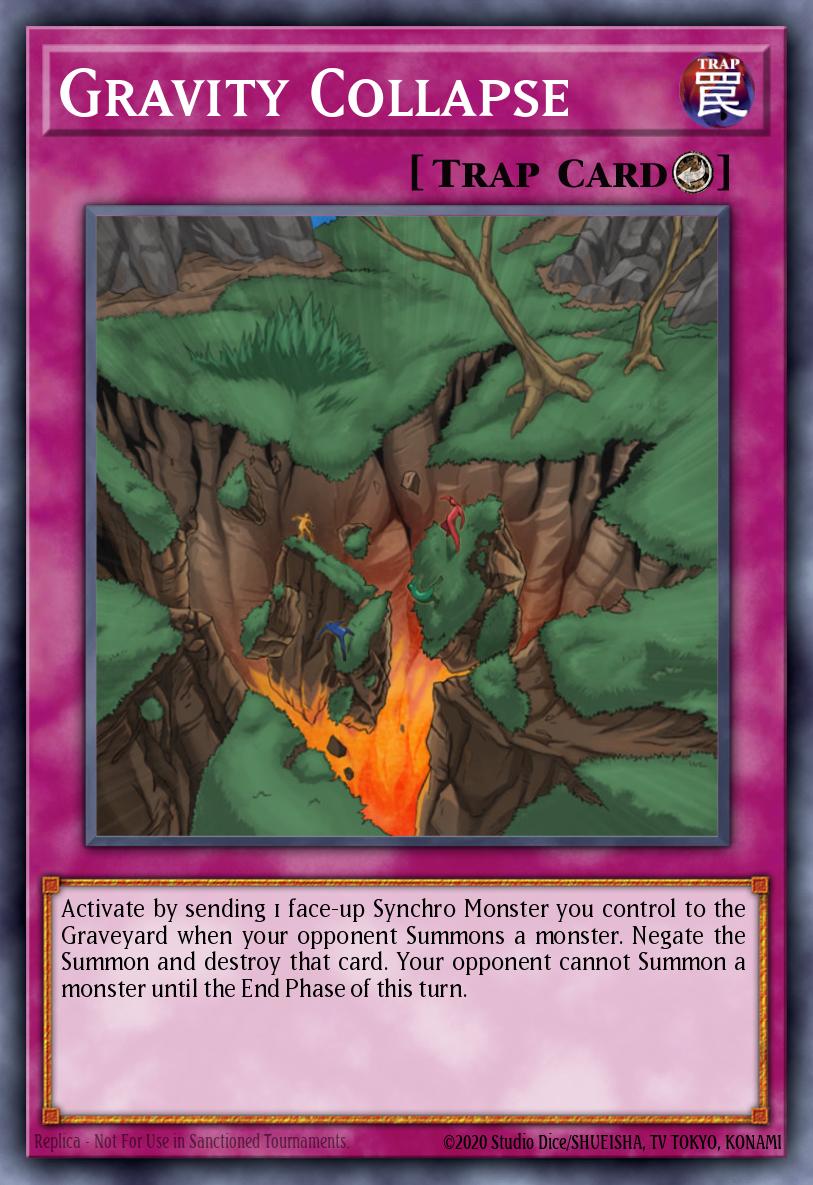
Gravity Collapse
View:
4656
Activate by sending 1 face-up Synchro Monster you control to the Graveyard when your opponent Summons a monster. Negate the Summon and destroy that card. Your opponent cannot Summon a monster until the End Phase of this turn.
Gravity Collapse — Power Evaluation
Final Score: 62 ± 6 · Confidence: Medium
- Intrinsic: 61 · Deck: 62.6 · Meta: provisional
- Primary role: Removal / Negation · Secondary: Floodgate/Control
Why it scores here
Gravity Collapse reliably converts a face-up Synchro Monster into a negated Summon, destruction of the summoned monster, and a lock that stops the opponent from Summoning any monster until the End Phase of the turn. Its score comes almost entirely from effect interaction, with a moderate accessibility score because the activation requires a face-up Synchro on your field. High deck inclusion (400 of 400 sampled decks, 2.4 average copies) confirms it is a consistently played interaction piece, but that frequency was not used to raise the score. It has no recorded combo or material value, so combo conversion and material utility stay low.
Axis scores
| Axis | Score | Evidence |
|---|---|---|
| Accessibility | 60 | Set-trap activation is available from the backrow, but it needs a face-up Synchro you control to send to the GY, so access depends on board state (verified from text; 0 combo appearances in evidence) (verified). |
| Combo & Conversion | 25 | No recorded boards; the card only converts a Summon into a denied turn and does not build a board on its own (inference from text; 0 combos supplied). |
| Resource Economy | 50 | It trades a Synchro body you send to the GY for an opponent's Summon, which is roughly even card economy with no searches or recursion (inference from text). |
| Effect & Interaction | 80 | Negates the Summon, destroys the monster, and locks further Summons until the End Phase, a strong and flexible response to the opponent's main play (verified from text). |
| Material Utility | 0 | A trap card has no body to use as material; the only material-adjacent role is the Synchro it consumes as a cost (verified from text). |
| Resilience & Flexibility | 45 | A face-down set trap is exposed to backrow removal, and it depends on a face-up Synchro staying on the field, but it covers a whole turn of Summons (inference from text). |
| Deck-Building Efficiency | 55 | Three-copy trap slot with no garnet or lock on the rest of the deck, but it only works in decks that field Synchro monsters (observed: 83.2% of sampled decks are gameplay type 7; inference from text). |
Calculation
Weight profile: 0.7 Removal/Negation + 0.3 Floodgate/Control. Intrinsic ≈ 61, Deck ≈ 62.6, Meta = provisional. Modifiers: Conditional Synchro cost (-2). Final formula: 0.40*Intrinsic + 0.60*Deck (Deck includes the -2 modifier; no meta sample supplied)
Strengths
- Negates a Summon and destroys the summoned monster in one activation
- Summon lock until the End Phase blocks the opponent's whole turn of Summons
- Runs in 400 of 400 sampled decks across 93 archetypes, so it is portable across homes
- Standard 3-copy slot with no garnet or lock on the rest of the deck
Weaknesses
- Needs a face-up Synchro Monster on your field to activate
- Set-trap, so it is exposed to backrow removal before it is used
- Contributes nothing to combos or material on its own
Counters / choke points
- Opponent has no Summon to make while you have no face-up Synchro on the field (verified from text)
- Backrow destruction before activation (inference; not in evidence)
Best use
Set trap that answers the opponent's Summon and locks the rest of that turn's Summons. Decks: Synchro-based decks such as Synchron, Resonator, Elfnote, and Archfiend lines (observed from the archetype list in decks_evidence). Suggested copies: 3.
Evidence & gaps
- Verified: Activation cost: send 1 face-up Synchro Monster you control to the Graveyard (card text); Effect: negate the Summon and destroy the monster, and the opponent cannot Summon until the End Phase (card text); Runs in 400 of 400 sampled decks, average 2.4 copies (decks_evidence)
- Observed: Appears in 93 distinct archetypes, with 83.2% of sampled decks in gameplay type 7 (decks_evidence); Co-occurs with Ash Blossom & Joyous Spring in 79.5% of decks and Droll & Lock Bird in 74.8% (decks_evidence); usage_statistics covers 2 archetypes at 100% inclusion, a small historical sample (usage_statistics)
- Inferred: The card is a Synchro-gated negation trap whose main value is denying a whole turn of Summons (text-level conclusion); Its role is consistent across homes because it is a standard interaction slot rather than a combo piece (decks-level conclusion)
- Data gaps: no combos supplied, so combo conversion is text-only inference no banlist token, assumed 3 copies (unlimited) usage_statistics covers only 2 archetypes, so inclusion is weakly calibrated no recorded boards to confirm how often the Synchro cost is payable in practice